Few cities in the world possess a historical, religious, and political significance that extends far beyond their geographical boundaries. Jerusalem stands out in this respect as a unique city, as it holds profound historical and political significance for the adherents of the three major monotheistic religions—Christianity, Islam, and Judaism. It serves as a symbol of collective identity and, by virtue of its sacred status, represents a place of profound spiritual importance. For these very reasons, the status of Jerusalem constitutes one of the most complex and sensitive issues in the Middle East and may also be regarded as an arena in which the interests of the world’s major powers intersect.
Religion has historically been inseparable from politics in practice, and it is precisely for this reason that Jerusalem’s religious significance cannot be considered independently of its political influence, particularly at the regional level, but also in a broader international context. Although the ongoing conflicts in the Middle East, especially the conflict in Gaza, whose principal parties are Palestinians and Israelis, encompass national, ethnic, historical, and ideological dimensions, they undoubtedly also possess a religious dimension. At the heart of these conflicts lies the aspirations of different religious communities to establish full control over a land they regard as sacred—Jerusalem in particular.
For Jews to fully observe their faith, they must perform certain religious practices and adhere to a set of religious laws known as Halakha. Of particular importance is the Temple of Solomon, which was destroyed twice: first by the Babylonians and later by the Romans. According to Biblical tradition, King Solomon built the Temple on Mount Zion, the sacred site where Abraham was prepared to sacrifice his only son, Isaac, in obedience to the Lord’s command. Jews also believe that the creation of the world began on Mount Zion, where God created Adam from the earth and breathed life into him, and where Adam’s body was subsequently buried. The rock upon which Solomon’s Temple was built is regarded by Jews as the “Foundation Stone” of the world. Furthermore, they believe that the cave beneath the Temple may contain the Ark of the Covenant, which, according to tradition, was concealed by the prophet Jeremiah before the Babylonian invasion. The Ark is believed to have contained the two tablets inscribed with God’s Commandments, a vessel of manna, and Aaron’s blossoming rod. According to many observers, these religious beliefs help explain the Israeli authorities’ efforts to conduct archaeological excavations on the Temple Mount (Al-Haram al-Sharif), which is also represents a form of political pressure on Muslims and Al-Aqsa Mosque.
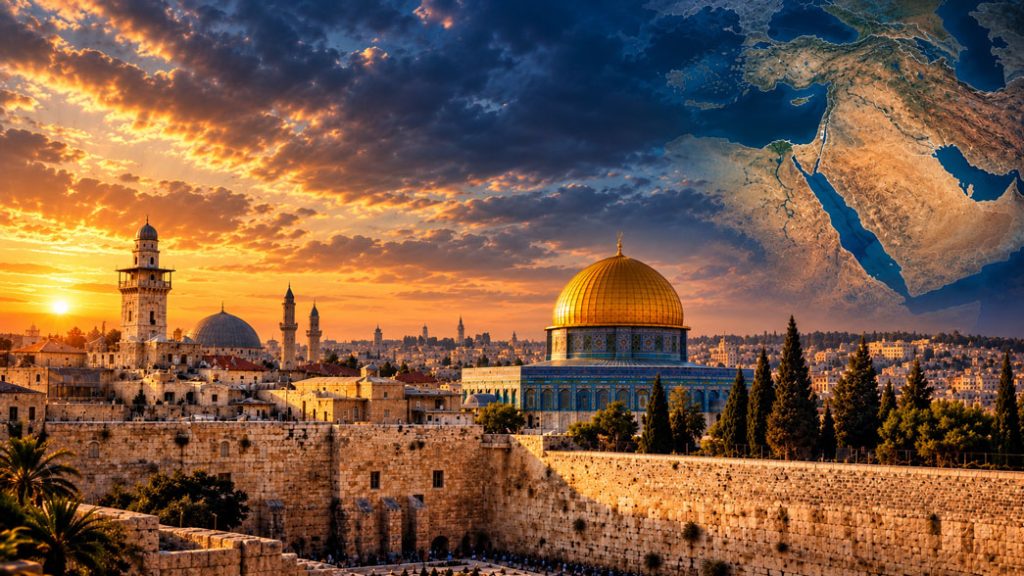
Despite the destruction of their Temple and their own expulsion from the land they regard as their ancestral homeland and sacred territory, Jews have never abandoned the idea of returning to Jerusalem and constructing a Third Temple on the very site where the previous Temples once stood. This aspiration is not, of course, shared by all Jews. Some believe that the time is not yet right and that the political instrumentalization of such an undertaking should be avoided. The most radical proponents, however, maintain that the construction of the Third Temple is a prerequisite for the coming of the Messiah, which, according to their interpretation, would be followed by Jewish dominion over the entire world. There have been reports that preparations for the construction of the Temple are already well advanced, with everything allegedly in place, from architectural plans and building materials to ritual objects and supplies required for Temple worship. These preparations are also said to include red heifers, whose sacrifice is associated with the relevant purification rituals. Nevertheless, a fundamental obstacle remains: the site on which some Jewish groups aspire to build the Third Temple is currently located the Al-Aqsa Mosque and the Dome of the Rock, which holds profound religious significance for Muslims and is widely regarded as the third-holiest site in Islam, after Mecca and Medina. Therefore, Jews would have to demolish the holy mosques in order to build their Temple, an act that Muslims would regard as nothing short of an apocalypse. Consequently, they would never allow such a thing to happen. Such a prospect makes the issue exceptionally sensitive and helps explain why the Temple Mount remains one of the principal focal points of religious tension and a significant factor in the broader conflict in the Middle East.
One of the most magnificent events in Islamic theology, in the humble opinion of the author of this article, is undoubtedly the Prophet Muhammad’s Night Journey and Ascension, known as Isra and Mi’raj. According to Islamic tradition, Muhammad, who frequently rested and prayed to Allah near the Kaaba, fell asleep one night and was awakened on the third occasion by the angel Jibril (Gabriel). The angel then brought him to a white, winged creature named Buraq, described in some traditional accounts as having a woman’s face and a peacock’s tail. Muhammad mounted Buraq and, accompanied by Jibril, travelled to Jerusalem, from where he ascended through the seven heavens. During this journey, Muhammad encountered various prophets, witnessed the splendour of the heavens, and reached the Lote Tree of the Utmost Boundary (Sidrat al-Muntaha). There, he received Allah’s command concerning the five daily prayers (salat), as well as the fundamental principles of faith that Muslims are required to observe. According to tradition, Allah had initially prescribed fifty daily prayers; however, Muhammad humbly pleaded for a reduction in their number to five, with each prayer retaining the spiritual merit of ten, thereby easing the burden on the Muslim community (Ummah). Following his encounter with the divine, Muhammad returned first to Jerusalem and subsequently to Mecca, arriving while it was still night. Within Islam, the Prophet’s Night Journey and Ascension is understood as a divine reward for his sacrifices and tireless efforts to spread the faith. Whether Muhammad’s journey occurred physically, spiritually, or through a combination of both, it undoubtedly established Jerusalem as a site of profound religious significance within Islam. The Al-Aqsa Mosque and the Dome of the Rock are closely associated with the Islamic tradition of this miraculous event and stand as enduring architectural expressions of Jerusalem’s sacred status in the Muslim world.
Although Jerusalem is not currently at the epicentre of the region’s political developments, it remains a city of immeasurable religious, spiritual, and historical significance for Christians. Regarded as a holy city and the cradle of the Christian faith, Jerusalem is associated with the most important events in the life of Jesus Christ. These include his Passion, Crucifixion, and Resurrection, through which Jerusalem has come to symbolise Christ’s sacrifice, his triumph over death, and the hope of believers for salvation. Jerusalem is home to some of the most significant sacred sites in Christianity, including the Holy Sepulchre, the site associated with the descent of the Holy Spirit, and the Tomb of the Virgin Mary. It is also the site of the Holy Fire ceremony, which takes place on Holy Saturday, on the eve of Orthodox Easter. In Orthodox Christian tradition, the Holy Fire is regarded as a manifestation of the Holy Spirit and a confirmation of Christ’s Resurrection. Jerusalem thus represents the foremost centre of religious identity and pilgrimage for Christians worldwide. Furthermore, Jerusalem occupies an important place in Christian eschatological tradition, particularly in interpretations concerning the Second Coming of Jesus Christ, an event associated with the end of the world and the fulfilment of divine purpose.
It is precisely the intertwining of the religious traditions of the three monotheistic religions that makes Jerusalem exceptionally important in Middle Eastern politics. Finding a lasting political solution to the status of Jerusalem is undoubtedly one of the most significant challenges in resolving the region’s conflicts. However, all indications suggest that such a solution is unlikely to emerge, at least in the foreseeable future. The current situation may perhaps best be described as a status quo, given that adherents of all three religions continue to find ways to practice their faith, while each community maintains the conviction that truth and justice are on their side. Under such circumstances, even a partial concession to another religious community could be interpreted as a betrayal of one’s own beliefs and a departure from divine will. Although Jews do not exercise exclusive control over the Temple Mount, after nearly two thousand years of exile, they have established their own state, which is not recognised by some Muslim-majority countries, and Israel formally exercises sovereignty over Jerusalem. Jewish worshippers pray at the Western Wall, also known as the Wailing Wall, which serves as a tangible reminder of the ancient Temple. For Muslims, the continued access to the Temple Mount, and to its sacred structures—the Al-Aqsa Mosque and the Dome of the Rock—is of particular importance. Christians, meanwhile, retain access to numerous sacred sites throughout the city, most notably the Church of the Holy Sepulchre, which they regard as the site of Christ’s crucifixion, burial, and resurrection and, in a profound spiritual sense, as the centre of their religious world.
A tenth-century Arab geographer once observed: “One prayer in Jerusalem is better than a thousand prayers elsewhere. God forgives those who come to Jerusalem, and they are absolved of their sins. Whoever has visited Jerusalem shall enter Paradise.” Drawing on the wisdom encapsulated in this statement, one might argue that, rather than pursuing an exclusively political solution, believers should seek a spiritual one. What belongs to the physical realm cannot be possessed by everyone, whereas that which is spiritual can be cherished by all within their hearts. From this perspective, the ultimate aspiration of all believers should be to attain the Heavenly Jerusalem, a spiritual ideal that transcends territorial boundaries, political divisions, and religious rivalries. Moreover, the very name Jerusalem is often associated with the Hebrew elements yero—interpreted in some accounts as referring to a foundation—and shalem, meaning peace or completeness. Thus, Jerusalem is frequently understood as the “City of Peace,” despite bearing, within its ancient walls, the scars of a turbulent past marked by numerous wars and protracted conflicts. This enduring contrast between the city’s spiritual symbolism and its historical reality underscores the profound paradox at the heart of Jerusalem: a place revered as sacred by millions, yet repeatedly transformed into a battleground over faith, identity, and political power.